Polynomial
Realtime collaboration infrastructure
A realtime collaboration platform for React apps. Presence, broadcast events, and CRDT-backed durable storage run over one WebSocket protocol, published as SDKs that are API-compatible with Liveblocks.
Why Polynomial exists.
Multiplayer is the feature teams keep postponing. Cursors are easy. Ordering, persistence, reconnects, and fanout across processes are not.
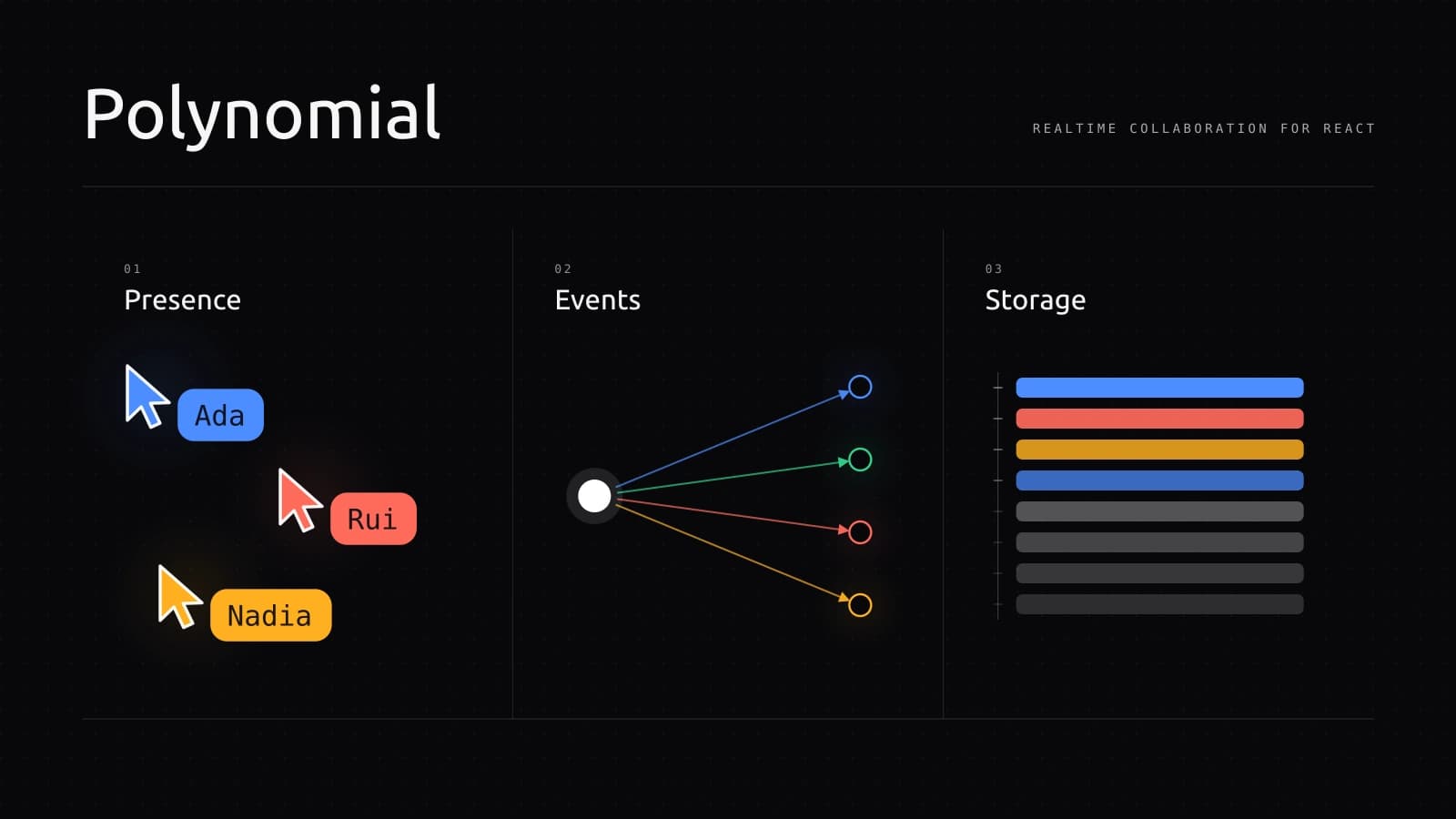
Polynomial is a hosted realtime collaboration service for React applications. A room gives an app three things: who is here, what just happened, and what is durably shared. The SDK hides the WebSocket, the CRDT, and the recovery path behind hooks that look like ordinary state.
It also ships as a drop-in replacement for Liveblocks. The same provider, the same hooks, the same server helpers, published under the import paths an existing app already uses. Migration is an import change, not a rewrite.
What the platform includes.
- RoomProvider · useStorage() · useMutation()
- Presence, others, and broadcast listeners
- Undo, redo, and history state
- Connection and sync status for the UI
- Framework-agnostic room primitive
- Immutable JSON storage with path updates
- Yjs bridge with a pending-update outbox
- Injectable transport for tests and demos
- Locally signed room and identity tokens
- Room create, update, upsert, and delete
- Storage reads and server-side broadcasts
- Zod-validated request and response shapes
- Projects, rooms, and storage inspection
- Key creation, rotation, and revocation
- Per-project realtime event logs
- Docs whose demos run the real SDK
What it looks like
to use.
The backend has one job. Decide who may enter a room, and sign a short-lived token. Everything else is a provider and a few hooks. useStorage returns plain JSON, and useMutation writes to it the way a reducer would.
import { PolynomialServer } from "@polynomialhq/server"; const polynomial = new PolynomialServer({ secretKey: process.env.POLYNOMIAL_SECRET_KEY!,}); // Your app decides who may enter. Signing is local, with no round trip.export async function POST(request: Request) { const { room } = await request.json(); const user = await requireSession(request); return Response.json({ token: polynomial.authorizeRoom({ projectId: process.env.POLYNOMIAL_PROJECT_ID!, roomId: room, role: "write", userId: user.id, userInfo: { name: user.name }, }), });}import { createClient, PolynomialProvider } from "@polynomialhq/react"; // One client for the app, created outside renderconst client = createClient({ authEndpoint: "/api/polynomial-auth" }); export function Providers({ children }) { return <PolynomialProvider client={client}>{children}</PolynomialProvider>;}import { RoomProvider, useMutation, useOthers, useStorage } from "@polynomialhq/react"; function Canvas() { const blocks = useStorage((storage) => storage.blocks); const others = useOthers(); const move = useMutation(({ storage }, id, x, y) => { storage.updateAt(["blocks", id], (block) => ({ ...block, x, y })); }, []);}How the system is
put together.
Two services, split by the shape of their traffic. A realtime worker holds long-lived WebSocket connections and owns the room document. A stateless REST API handles administration, storage reads, and server-sent broadcasts. Postgres holds everything durable. Redis carries nothing that cannot be rebuilt.
From a token
to a live room.
A join is a handshake, not a single step. Verify the signature, guarantee the room row exists, rebuild the document from a snapshot plus the newer tail, then start streaming. Only after that does an edit get a sequence number and an acknowledgement.
What happens to
one edit.
Application code writes plain JSON. Underneath, the SDK diffs that JSON into granular Yjs nodes so two people editing different fields of the same object do not overwrite each other. The update sits in an outbox until the server returns a sequence number, which is what lets the UI say honestly whether it is synchronized.
// One partial unique index makes a room's log strictly ordereduniqueIndex("yjs_updates_room_sequence_idx") .on(table.roomId, table.sequence); uniqueIndex("yjs_updates_room_update_id_idx") .on(table.roomId, table.updateId) .where(sql`${table.updateId} is not null`);The room-scoped sequence is the contract the rest of the system leans on. It orders the append-only log, tells a rejoining client which tail it still needs after a snapshot, and gives the outbox something concrete to wait for. The second index makes a retried update collapse into the write it already made.
One room, many
processes.
Two people in the same room routinely land on different worker processes. Each room gets a Redis channel, and it carries more than message fanout. It answers presence snapshot requests, tracks which nodes still serve the room, and lets the REST API broadcast into a room it holds no socket for.
A contract both sides import.
The protocol lives in its own package as Zod schemas, and both the browser and the worker parse against them. The boundary rejects a malformed frame with a typed error code before it reaches handler logic, and a version field on every message leaves room to change the shape later without breaking older clients.
- room.join
- room.leave
- presence.update
- broadcast
- yjs.update
- ping
- room.joined
- room.left
- presence.updated
- presence.sync
- broadcast
- yjs.update
- yjs.sync
- yjs.ack
- error
- pong
What each channel guarantees.
- Lives only while the socket is open
- New joiners get a presence.sync snapshot
- Collected across worker processes
- Never written to Postgres
- Delivered the instant it is sent
- Never replayed to later joiners
- Echoed back to the sender by design
- Also sendable from a trusted backend
- Yjs updates, appended with a sequence
- Survives reconnects and restarts
- Rebuilt for every new connection
- The only channel with undo and redo
- read joins and publishes presence
- write adds broadcasts and storage
- admin covers privileged clients
- Enforced on the worker, not the client
- Reconnect backs off to a 10s ceiling
- Unacknowledged updates stay in the outbox
- Rejoin replays snapshot plus tail
- Storage status is exposed to the UI
A migration that
touches nothing.
The hard part of any infrastructure product is not the first install. It is the switching cost of whatever is already in place. Polynomial answers that by publishing thin alias packages that re-export its own SDKs under the Liveblocks import paths, and by keeping the hook and helper names identical underneath.
// The same app, running on Polynomial. Only resolution changed.import { RoomProvider, useOthers } from "@liveblocks/react"; // packages/liveblocks-react/src/index.tsexport * from "@polynomialhq/react";The compatibility layer is deliberately thin: three packages that do nothing but re-export. The parity work lives in the real SDKs. They implement a Liveblocks-shaped session builder, access constants, and the LiveObject, LiveMap, and LiveList structures against Polynomial's own room model.
Where each kind of state lives.
Rooms are addressed by the application's own identifier, unique per project, so a customer never has to store a mapping. Document history is an append-only log with periodic compaction rather than a mutable blob, which keeps writes cheap and makes recovery a replay instead of a repair.
- organizations
- projects
the workspace boundary every other row hangs off
- api_keys
sha256 hashes, looked up by a 20-character prefix
- rooms
- room_usage
one durable row per project and external room id
- yjs_updates
- yjs_snapshots
append-only updates plus periodic compacted state
- project_event_logs
joins, leaves, broadcasts, and persisted updates
What I optimized for.
Tokens are signed, not fetched
Authorization is an HMAC over claims the backend already has, so the auth endpoint never waits on a network call to issue one.
Persist before fanout
An update is written and given a sequence before it reaches anyone else, so nobody sees state the server would lose on restart.
Granular CRDT nodes
JSON is diffed into per-field Yjs structures rather than replaced wholesale, which is the difference between merging concurrent edits and clobbering them.
One protocol package, both ends
Client and server import the same schemas, so a shape change fails at compile time instead of at 3am in production.
Base64 JSON frames, not binary
Yjs updates ride inside JSON messages. It costs bandwidth, and it buys a protocol that is readable in a network tab and validated by one schema package.
Snapshot history over full undo
Undo and redo replay storage snapshots rather than inverting CRDT operations. Predictable for a single user, not a shared timeline.
Redis is required for scale-out
Without it the worker still runs, but fanout stops at the process boundary. Single-node deployments work; multi-node ones do not degrade gracefully.
Compatibility follows the surface, not the wire
Liveblocks apps can move by changing imports, but nothing speaks the Liveblocks protocol. The parity is at the API, not the socket.
Where the design can fail.
- 01
A reconnect that silently drops an edit
The socket closes mid-write more often than anyone plans for. Unacknowledged updates have to survive the gap and be replayed on rejoin, or a user loses work they watched appear on screen.
- 02
Two writers, one object
Whole-object replacement is the easy implementation and the wrong one. Concurrent edits to different fields have to merge, which is why the JSON layer is diffed into granular CRDT nodes.
- 03
A room split across processes
Presence and broadcasts are only correct if every node serving a room can reach the others. New connections also need to learn about people who were already there on a different process.
- 04
An unbounded update log
Append-only writes are cheap until a rejoin has to replay a hundred thousand of them. Periodic snapshot compaction is what keeps join latency flat as a document ages.
What the product does not cover yet.
- Collaboration
Presence, broadcasts, and storage. No comments, threads, or notification surface.
- Deployment
Single-region, single-VM compose stack. No multi-region or failover story shipped.
- Operations
Event logs and usage counters exist. No quotas, billing, or per-room rate limiting yet.
What the product sets out to make easier.
A provider, a room, and two hooks. The document model, the socket, and the merge semantics stay inside the SDK instead of becoming the consuming team's problem.
Backoff reconnects, a pending-update outbox, and snapshot-plus-tail hydration mean a dropped connection resolves itself rather than turning into lost state.
Apps already on Liveblocks can evaluate Polynomial without rewriting components, which turns a migration decision into a reversible experiment.
What I would carry forward.
- 01
The protocol is the architecture
Writing the message schemas before either side existed forced the hard questions early. What does a join guarantee? What does an acknowledgement mean? The services mostly fell out of the answers.
- 02
Acknowledgement beats optimism
The moment the server started returning a sequence per update, the client could tell the truth about sync state, retry safely, and stop guessing whether a reconnect had cost anything.
- 03
Compatibility is a product feature
Matching an incumbent's API is not imitation. It removes the largest reason a team says no. Three re-export packages take more friction out of that decision than any feature I could have added.
- 04
Realtime is mostly reconnect
The happy path took a fraction of the work. Everything that makes the product feel dependable lives in what happens after the socket closes.
Pigeon
Multi-tenant notifications platform