Pigeon
Multi-tenant notifications platform
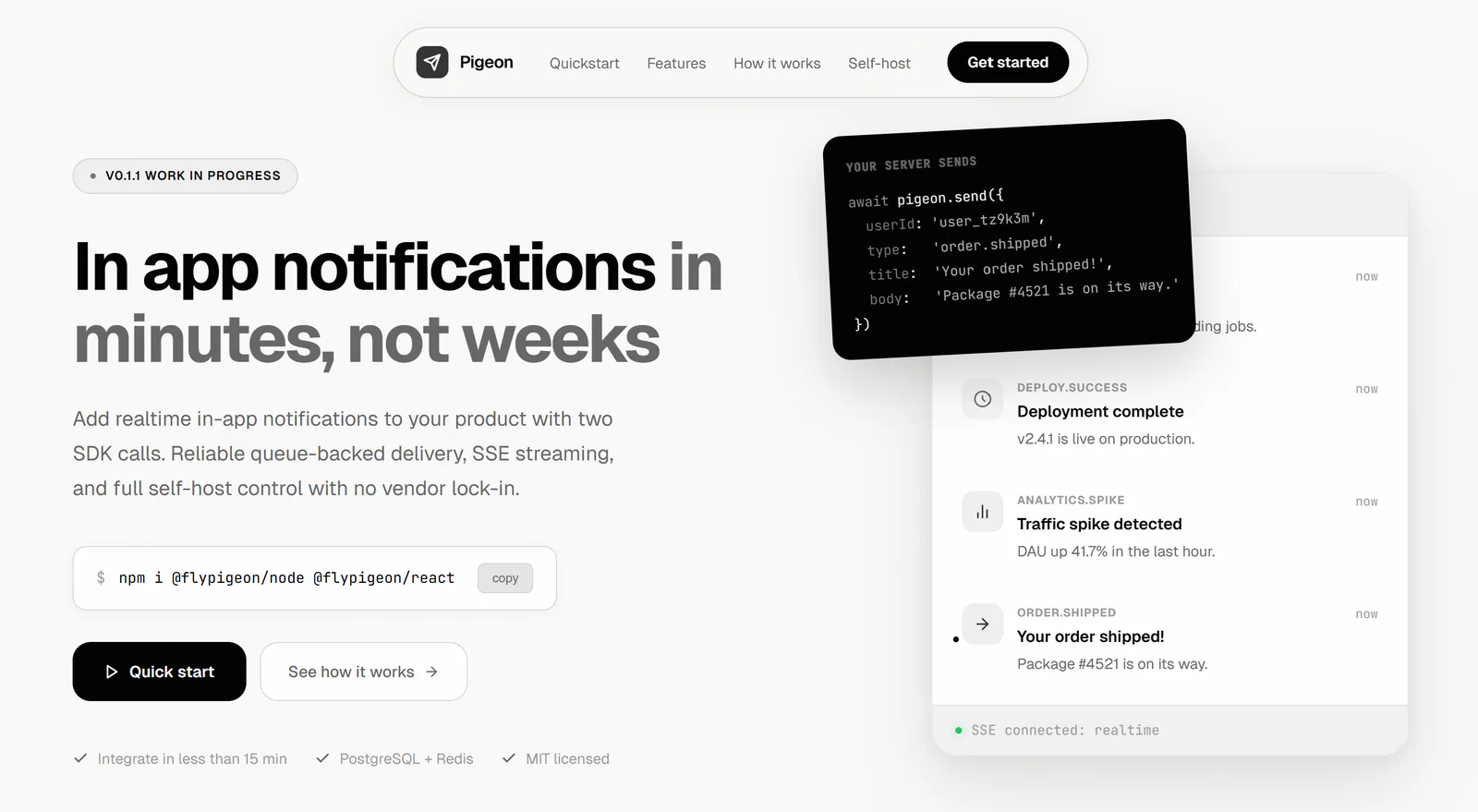
A notifications product with a backend SDK for sending events and a frontend SDK for reading them. The API accepts and persists, workers render and fan out, and the React SDK keeps an inbox live across reconnects.
Why Pigeon exists.
Most teams start notifications as a database table and a frontend badge. Pigeon treats them as a product of their own from the first commit.
Backends should call one client to send. Frontends should mount a provider and render a bell that stays live, survives reconnects, and reads optimistically. Customers should receive signed webhooks with retries that leave evidence. Nobody should have to assemble that from scratch inside their own app.
The result is a TypeScript monorepo: an API, a worker, a web dashboard, a Node SDK, a React SDK, and a demo that exercises the full loop end-to-end.
What the platform includes.
- send() · sendBatch() · createUserToken()
- Validates inputs before network
- Configurable transport and timeout behavior
- Typed API · network · validation errors
- PigeonProvider · useNotifications() · NotificationBell
- Token caching with automatic refresh
- SSE reconnect with backoff
- Optimistic mark, mark-all, archive
- Typed HTTP API with request tracing
- Background workers split by responsibility
- Schema-level idempotency guarantees
- Signed webhooks · attempt log per send
- Projects · environments · members
- API key management with safe storage
- Logs · users · templates · webhooks
- Dashboard auth and role-based access
What it looks like
to use.
The platform's job is to disappear behind two SDKs. A backend sends with one call and mints a client token with another. A frontend mounts a provider and drops in a bell. Validation and typed errors live at the boundary, not inside the consuming app.
import { Pigeon } from "@flypigeon/node"; const pigeon = new Pigeon({ apiKey: process.env.PIGEON_API_KEY! }); // Send a notification from your backendawait pigeon.send({ userId: "user_123", type: "comment.reply", title: "New reply", body: "Alex replied to your comment", data: { threadId: "t_42" },}); // Mint a short-lived token for the browserconst { token, expiresAt } = await pigeon.createUserToken({ userId: "user_123", ttlSeconds: 3600,});import { PigeonProvider, NotificationBell } from "@flypigeon/react"; // Drop-in inbox: a provider and a bellexport function App() { return ( <PigeonProvider apiUrl={API_URL} tokenProvider={fetchToken}> <NotificationBell panelTitle="Inbox" pageSize={20} /> </PigeonProvider> );}import { useNotifications } from "@flypigeon/react"; // Or build a custom UI on the hookfunction Inbox() { const { notifications, unreadCount, markRead, markAllRead } = useNotifications();}How the system is
put together.
The Node SDK sends. The API persists the request, hands work to background processing, and returns. Workers render, publish live updates, and dispatch signed webhooks. The React SDK opens an SSE stream and resumes cleanly after reconnects. Underneath, one Redis instance does four jobs: queue, pub/sub, replay log, and rate limiter. Postgres holds everything durable.
From send
to delivery.
Accept fast, deliver async, fan out everywhere. The send returns after durable persistence and job handoff. The slower work stays out of the caller's request path.
Projects, environments,
and scope.
Projects are top-level. Each project has development and production environments with their own scoped credentials. Almost everything that matters, including keys, users, notifications, templates, and webhooks, lives behind an environment, not just a project.
Separate trust
boundaries.
Backends authenticate with long-lived API keys, hashed at rest and matched by prefix. Frontends use short-lived JWTs, minted per end user and signed with a per-environment secret. The budgets differ too. A Redis sliding window caps key-based writes at 100 req/s and token-based reads at 1000 req/s, answering 429 with retry-after. Different blast radius, different limits, one API enforcing both.
How tenancy shows up in the schema.
The schema follows one rule. Human collaboration lives at the project level, while credentials, recipients, notifications, templates, and webhooks are scoped per environment. That keeps tenancy visible in the data model instead of depending on scattered application checks.
- users
- sessions
- accounts
- verifications
Better Auth for dashboard sign-in, not end users
- projects
- project_members
- project_invites
- environments
workspace and membership boundaries
- api_keys
- end_users
credential storage and recipient identity
- notifications
- templates
delivery records, content, and idempotency
- webhook_endpoints
- webhook_delivery_attempts
delivery destinations and attempt history
// notifications table (Drizzle)uniqueIndex("notifications_environment_idempotency_unique") .on(table.environmentId, table.idempotencyKey) .where(sql`${table.idempotencyKey} IS NOT NULL`);A partial unique index makes duplicate sends impossible per environment. The guarantee lives in Postgres, not in application code that every caller has to remember.
Live delivery
with replay recovery.
Live fanout and reconnect replay run on separate paths. Connected clients receive updates immediately, while reconnecting clients get a short recovery window so brief network drops do not turn into missed notifications.
What each stage guarantees.
- Idempotent write, unique per environment
- Tenant scope resolved before any write
- Returns only after durable persistence
- Slow work handed to the queue, not the caller
- At-least-once worker semantics
- Title and body rendered from templates
- Marked delivered only after render
- One event, fanned out to every consumer
- Live fan-out over a single SSE channel
- Reconnects replay via Last-Event-ID
- Short-lived tokens, refreshed by the SDK
- Reads stay optimistic in the client
- Payloads signed with HMAC-SHA256
- Every attempt logged, success or failure
- Failures retried with exponential backoff
- A bad receiver never blocks delivery
- Cleanup runs off the hot path
- 90-day retention, deleted in batches
- Attempt history retained for audit
- Growth stays bounded and predictable
What I optimized for.
Idempotency at the schema layer
The persistence layer blocks duplicate sends. No caller has to remember to check first.
Durable state has one home
Transient coordination stays out of the system of record, so losing Redis costs a replay window and nothing else.
Write before enqueue
The notification commits before background processing begins, so failures surface clearly instead of disappearing into side effects.
Webhook attempts are first-class
Every attempt writes a row with its status code and response, so support can answer "did it fire?" without a log search.
SSE over WebSockets
The product needs one-way delivery, not full duplex messaging. SSE keeps the auth and reconnect story simpler for this scope.
At-least-once, not exactly-once
Workers may retry a job after partial success. Idempotency keys carry the weight at the boundaries.
Short replay buffer
Reconnect history exists to smooth over short disconnects, not to act as a permanent event ledger.
Single-region, by design
No multi-region or active-active deployment story yet. The MVP picks scope over posture.
Where the design can fail.
- 01
Slow side-effects on a hot path
Rendering, fanout, and logging cannot sit on the caller's request. The send has to return fast or every integration feels the slowest dependency.
- 02
Realtime across reconnects
Live fanout does not retain history. Reconnects need a cursor and a replay window the SDK can drive without consumer code.
- 03
Misbehaving webhook receivers
Endpoints time out, 5xx, or 200-then-crash. Delivery has to retry, and every attempt has to leave evidence.
- 04
Two callers, two trust boundaries
Backends authenticate with long-lived keys, frontends with short-lived tokens. Different blast radius, different rate budgets, one API.
What the product does not cover yet.
- Channels
In-app + webhooks today. No email, SMS, or push.
- Deployment
No multi-region, failover, or disaster-recovery story shipped.
- Identity
Basic dashboard authentication only. No SSO or enterprise identity layer yet.
What the product sets out to make easier.
One Node SDK call sends a notification, another mints a frontend token. Validation and typed errors live at the boundary, not inside the app.
A provider, a hook, and a bell. Token caching, reconnects, and optimistic reads are handled inside the SDK, not in consumer code.
Live events stream into the SDK while reconnects resume from the last seen event, so a backgrounded tab or a brief network drop doesn't turn into a lost notification.
What I would carry forward.
- 01
The SDK is the product
A platform is only as good as the libraries integrators actually touch. Two clean SDKs remove more friction than another feature behind a flag.
- 02
Realtime is two problems
Live delivery and replay want different storage. Solve them separately and they compose.
- 03
Tenancy belongs in the schema
Project and environment scoping lives in the indexes and uniqueness constraints, so a query that forgets its scope fails at the database instead of quietly returning another tenant's rows.
- 04
Keep the write path boring
Slow work goes to a queue, fast work stays inline. That line is the architecture.
Media Pipeline
Long-form to short-form, automated